Sometimes a bottle will look great when
you get it but crack in storage after a few months. Or a jerry can will pass
your initial tests but fail in the field.
Often issues arise because people start
by looking at price and grade name.
In this article I’m going to tell you
what an HDPE Blow Moulding grade is, what specifications are important and how
to find the right grade for your bottles, jars and industrial containers.
What Is an HDPE Blow Moulding Grade?
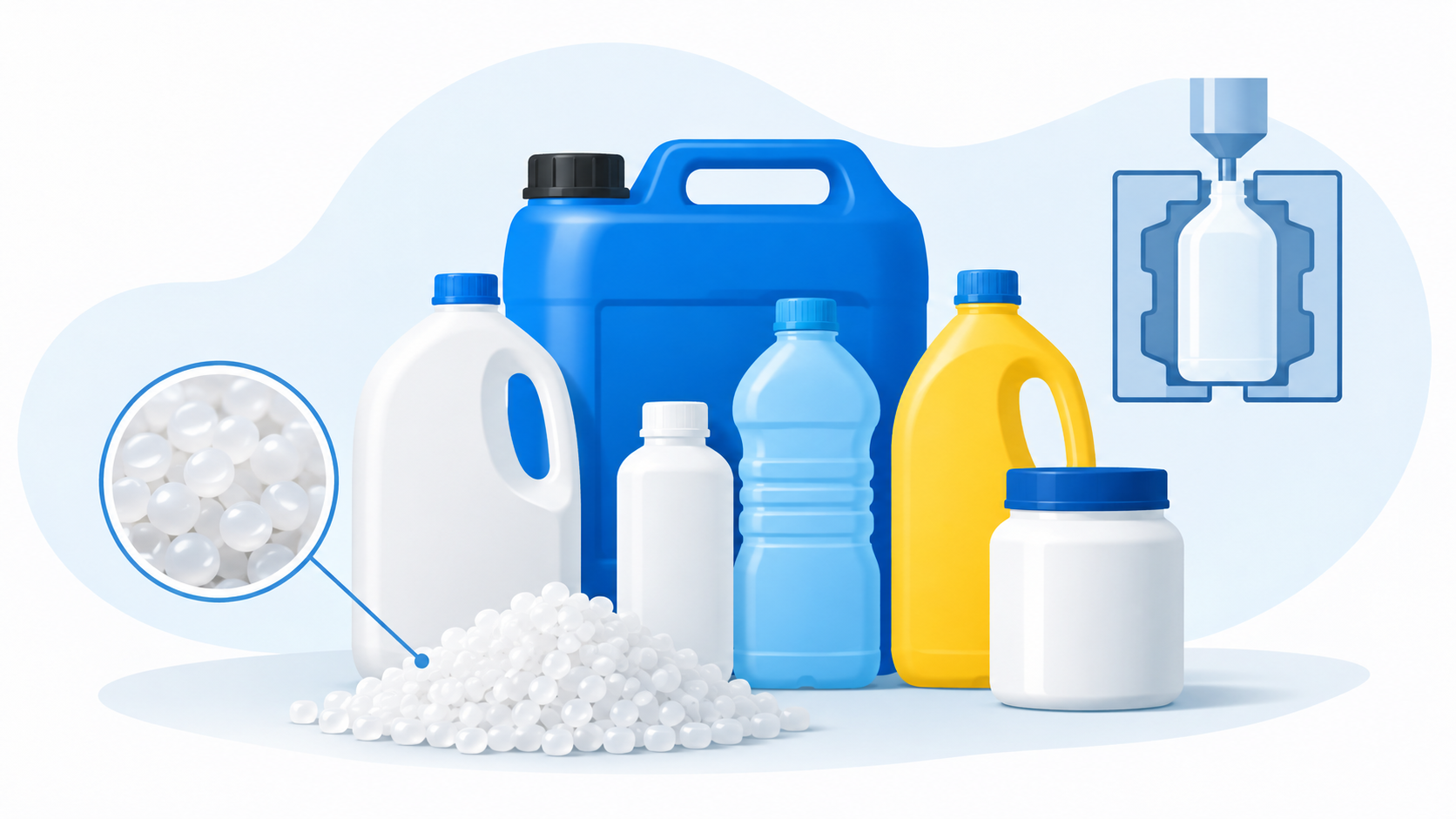
An HDPE blow moulding grade is a high density
polyethylene resin made for forming hollow parts. In extrusion blow moulding, a
hot tube of plastic is inflated inside a mould. It is the main route for HDPE
bottles, containers and tanks.
These grades usually have a low melt flow
index. One industry reference puts typical blow moulding grades at 0.1 to 1.0
g/10 min, much lower than most injection moulding grades.
Why Grade Selection Matters
The grade decides how stiff the container
feels, how it handles stacking, and whether it survives contact with its
contents. A wrong choice shows up late, as cracks, collapsed panels or leaks.
If you want the basics first, this read
on understanding the right polymer grade for your
application covers the general thinking before we get into HDPE.
Key Factors to Consider When Choosing an HDPE Blow Moulding
Grade
Five specs do most of the work. Check
them in this order and the shortlist gets smaller quickly.
1. Melt Flow Index (MFI) and Part Size
MFI is measured at 190°C under a 2.16 kg
load (ASTM D1238). A lower MFI means higher molecular weight, which helps
long-term stress resistance. In general, lower MFI suits large parts, while
higher MFI allows faster cycles on small containers.
2. Density and Stiffness
Higher density gives a stiffer container.
One technical reference lists standard grades for large containers at 0.948 to
0.955 g/cm³. There is a trade-off: LyondellBasell notes that stress crack
resistance tends to improve as density goes down.
3. Environmental Stress Crack Resistance (ESCR)
ESCR is how well the resin resists
cracking under stress while in contact with chemicals such as detergents. It is
commonly tested with the bent strip method (ASTM D1693) at 50°C in an Igepal
solution.
Compare ESCR numbers only when the test
conditions match. LyondellBasell warns that these tests are sensitive to
testing error.
4. Impact Strength and Top-Load Strength
Drums and jerry cans get stacked. A grade
with weak top-load performance can bulge or collapse in a warehouse even if it
never leaks.
5. Food Contact and Regulatory Needs
Check the grade's own documents. Dow's
guide, for example, lists FDA 21 CFR 177.1520 compliance per grade, and
describes one grade for containers that meet UN standards. LyondellBasell says
its recycled grades are not meant for regulated uses like food.
All of these numbers sit on the data
sheet. If you are unsure how to read one, this guide to interpreting HDPE resin specifications in a technical
data sheet walks through MFI, density, tensile values and more.
Matching Grades to Bottles, Jars and Industrial Containers
The table below shows how manufacturer
guides position different grades. These are illustrations from Dow's blow
moulding guide, not recommendations, and some of its grades are region
specific.
|
Container |
What
matters most |
Example
from the guide |
|
Bottles and jars up to 5 L |
Stiffness with good ESCR |
Density 0.956, MI 0.29, ESCR over 200 hours |
|
Jerry cans up to 30 L |
ESCR, top load, UN compliance |
Density 0.953, ESCR over 1,000 hours |
|
Drums up to 250 L |
Melt strength, ESCR |
Density 0.945, ESCR over 1,000 hours |
Notice the pattern. As containers get
bigger and carry harsher contents, density comes down and ESCR goes up.
Common Mistakes When Selecting HDPE Blow Moulding Grades
●
Choosing by MFI alone. Two grades with the same MFI can behave very differently under stress.
●
Ignoring ESCR for chemical
contents. Containers for detergents or chemicals can
crack along stress lines during storage.
●
Comparing ESCR across different
tests. Hours from different conditions are not
comparable.
●
Skipping compliance checks. Food contact and UN requirements belong in the first filter, not the
last.
●
Buying on price alone. A cheaper grade that fails in the field costs more.
Practical Recommendations
●
Write down the container size, the
contents and the storage conditions first.
●
Set a target range for MFI,
density and ESCR.
●
Ask for the data sheet and check
the test conditions behind each number.
●
Trial two or three grades, not
ten.
Once you have a shortlist, it helps to compare
available HDPE resin sourcing options against your target numbers.
Key Takeaways
●
Blow moulding grades typically use
low MFI, and the right level depends on part size.
●
Density and ESCR pull in opposite
directions, so balance them for the container.
●
Larger containers with harsher
contents usually need higher ESCR.
●
Compare ESCR only under matching
test conditions.
●
Check food and UN compliance
before anything else.
Conclusion
If I were starting from scratch, I would
note the container size, what goes inside and where it will be stored. Then I
would check three numbers on the data sheet: MFI, density and ESCR. That
usually cuts a long list of grades down to two or three worth testing. I hope
it saves you a failed trial or two.
FAQs
What MFI is best for HDPE blow
moulding?
Most blow moulding grades sit between roughly 0.1 and
1.0 g/10 min, with lower values for larger parts.
Which HDPE grade is used for jerry
cans?
Grades with high ESCR and good top-load strength; one
manufacturer lists a 0.953 density grade for containers up to 30 L.
Does higher density mean better ESCR?
No. Higher density adds stiffness, but stress crack
resistance tends to improve as density falls.
How is ESCR measured?
Commonly with the ASTM D1693 bent strip test at 50°C
in Igepal solution, or with the full notch creep test (FNCT).
Can recycled HDPE be used for blow
moulding?
Some recycled grades are sold for bottles up to 5 L,
but one manufacturer says its grade is not meant for regulated uses like food.