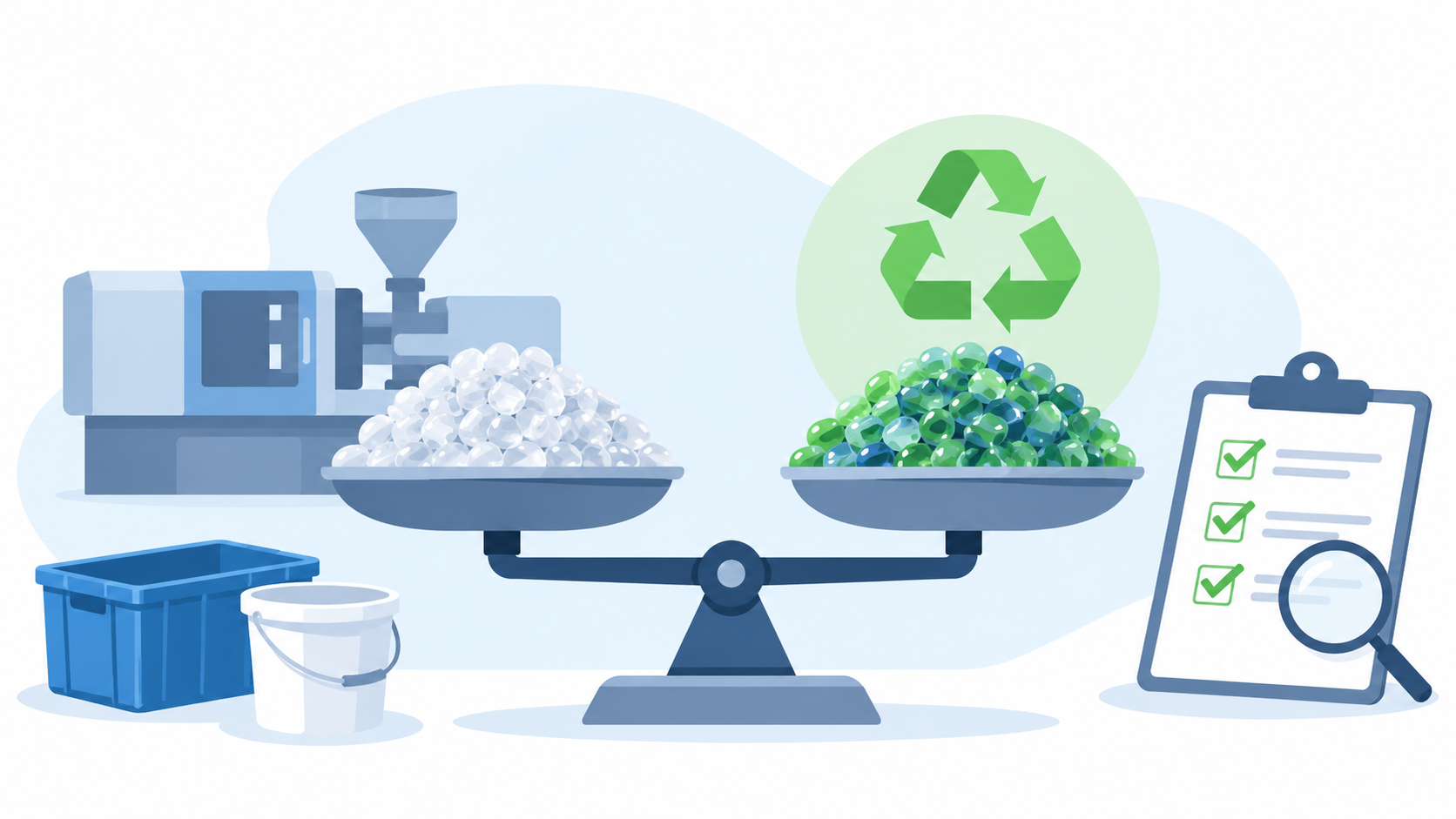
Recycled PP and PE look like an easy way
to cut raw material costs. The price is lower, supply is growing, and new rules
in India are pushing manufacturers to use more of it.
But the real question is whether the
material will run on your machine and arrive the same way next month. Keep
reading to see what to test, what can go wrong and how to lower the risk before
a bulk order.
What Does Evaluating Recycled PP and PE Mean?
Recycled PP (polypropylene) and PE
(polyethylene) are plastic granules made by cleaning, melting and
re-pelletizing used plastic. Evaluating them means checking that a specific lot
is clean, consistent and right for your process before you commit to volume.
Why Evaluation Matters in India Right Now
The Plastic Waste Management (Amendment)
Rules, 2026 were notified on 31 March 2026. Rigid packaging needs 30% recycled
content in 2025-26, rising to 60% from 2028-29, and recycled packaging must
conform to IS 14534:2023 and carry labeling.
So more manufacturers are buying recycled
material. The catch is that it varies far more than virgin resin, and a wrong
choice shows up later as weak parts or rejected batches.
Key Factors to Evaluate Before You Buy
The right criteria stop you from judging
granules by colour and price alone. I'd run these five checks in order,
cheapest first.
1. Know the Source of the Material
Ask whether the granules are
post-industrial scrap or post-consumer waste. Post-industrial is usually
cleaner, while post-consumer make-up depends on local waste composition and
sorting, so it can change between lots. Ask if the supplier can trace the
feedstock.
2. Check for PP and PE Cross-Contamination
PP and PE have almost identical
densities, so they are hard to separate, and they do not mix well in the melt.
A Politecnico di Torino study notes recycled HDPE typically carries 2% to 13%
PP.
A University of Manchester study,
reported by Resource Media, found HDPE tolerates roughly 3% to 8% PP, while PP
is hurt by as little as 1% HDPE. Ask how purity was checked, because DSC alone
can miss it.
3. Read MFI, Density and the Data Sheet
MFI is the quickest way to compare
recycled lots. The Polymer Technical Data Sheet Guide explains
how to read it, including why test conditions matter: PE is commonly tested at
190°C and PP at 230°C, both at 2.16 kg.
But MFI alone can mislead. A NETZSCH
application note says materials with the same MFI can fill a mold differently.
Ask for MFI across several recent batches, plus density and impact data.
4. Look at Odour, Moisture and Colour
Post-consumer material can carry food and
cleaning residues that cause odour, and limonene can stay in pellets unless the
recycler degasses them. Inspect pellets for black specks and colour variation,
smell a sample, and keep granules dry.
5. Test Compatibility With Your Process
A sample that looks fine can still
struggle on your machine. Run a trial batch on your own tooling before ordering
volume, ideally with a blend of recycled and virgin material. PP also degrades
with every extrusion pass, and the Manchester paper puts practical reuse at
around five passes.
Procurement Risks and How to Reduce Them
Good lab numbers do not help if the next
batch differs. Ask for a certificate of analysis for each lot, match the lot
number to the bags on arrival, and compare MOQ and payment terms side by side.
The guide on How to Buy Recycled Polymer Granules in India
covers the buying checklist in more detail. Gravita India cites an average
discount of 20% to 30% against virgin PP, but that is a supplier figure, so
treat it as a rough guide.
To compare offers, you can buy
bulk polymer raw materials online and review quotes together.
Product quality remains the seller's responsibility on the platform, so your
own checks still apply.
Practical Example
This example is illustrative, not a real
case. A houseware manufacturer wants to replace part of its virgin PP with
recycled PP for storage boxes. It asks for MFI data from the last five lots and
confirms the material is post-industrial. On arrival, the COA lot number is matched
to the bags, and a trial batch runs at 20% recycled content. Only after clean
parts does it raise the blend.
Common Mistakes
●
Buying on price and colour alone.
●
Treating one sample as proof of
consistent supply.
●
Relying on MFI as the only number.
●
Assuming a bag labelled
"PE" or "PP" holds only that polymer.
●
Skipping the trial run and
ordering full volume.
Key Takeaways
●
PP in PE and PE in PP do not hurt
equally, so ask how purity was checked.
●
MFI is a screening number, not
proof the material will run well.
●
A trial batch on your own machine
is the real test.
Conclusion
Recycled PP and PE can work well in
manufacturing when you check the lot and not just the label. Ask for batch data
and a COA, test for contamination, run a trial on your own machine and compare
quotes like for like. I hope this gives you a clearer idea of what to ask
before your next order.
FAQs
Is recycled content mandatory in
India?
For packaging producers, importers and
brand owners, yes, starting at 30% for rigid packaging in 2025-26.
Can PP and PE be mixed in one batch?
Not freely, since small amounts of the
wrong polymer can reduce toughness.
Is MFI enough to judge recycled
granules? No, materials with the same MFI can fill a
mold differently, so run a trial.
Which is more sensitive to
contamination, PP or PE?
PP, as the Manchester study found as
little as 1% HDPE hurts PP, while HDPE tolerates roughly 3% to 8% PP.
Should my first order be 100% recycled
material?
Many manufacturers start with a blend and
raise the recycled share after clean trial runs.