When selecting PP raffia for sack
weaving, you need to match the resin properties (melt flow and strength) to
your extrusion and weaving equipment. This can be done by referring to the data
sheet and batch certificate from your supplier.
If you're looking for information because
you're manufacturing fertilizer bags, grain sacks or FIBC fabric, you will know
how frustrating it can be. Sometimes grades look identical on your quotation
but can be completely different when you get to your tape line and start having
issues. In this guide I will explain what PP raffia is, what properties to look
for, how to interpret your documentation and what to look out for when
purchasing.
What Is PP Raffia Grade for Woven Sacks?
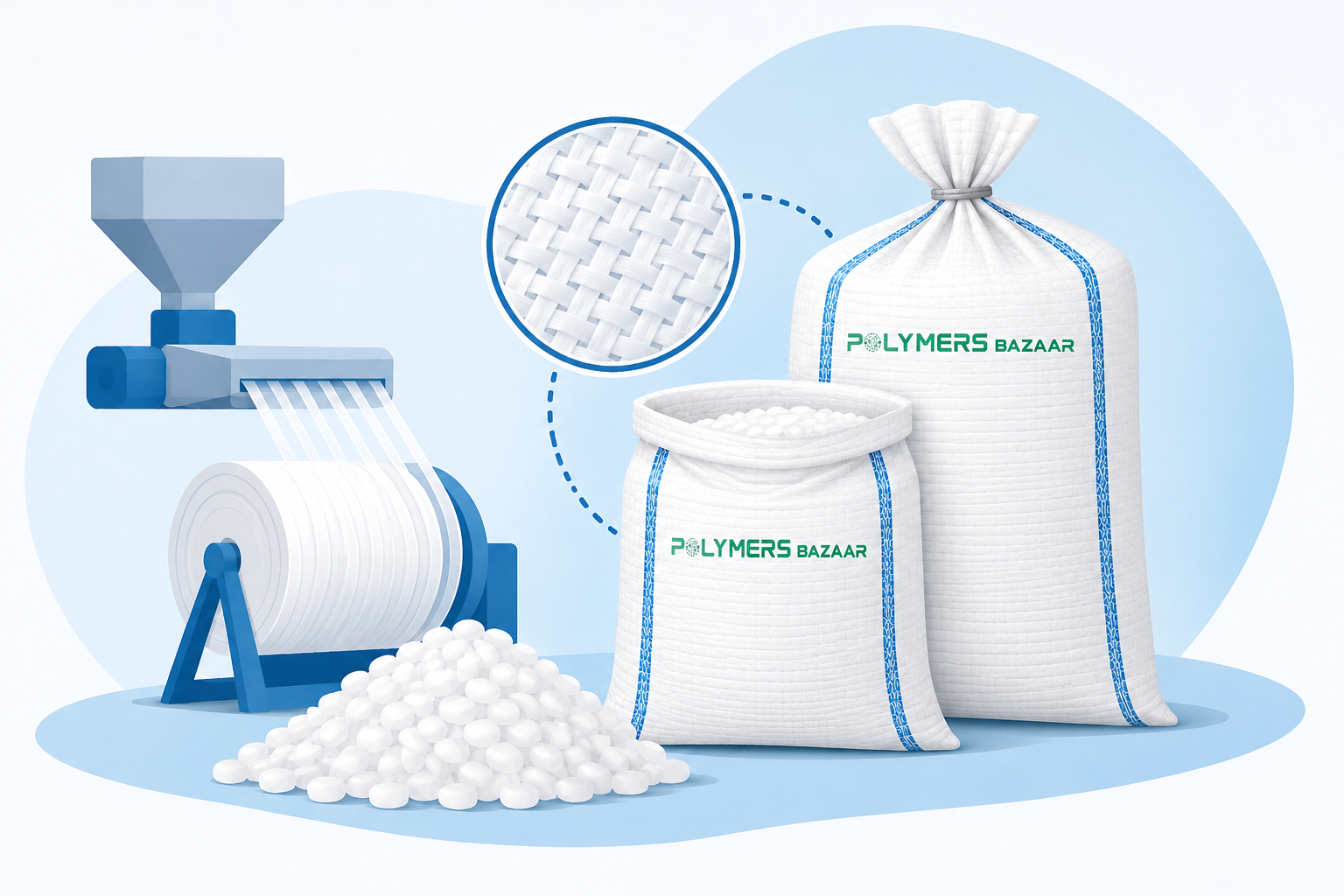
PP raffia grade is homopolymer
polypropylene made for extruding flat tapes that are stretched and woven into
fabric. Typical grades have a melt flow index of about 2 to 5 and a density of
0.90 to 0.91 g/cm³. That mix gives high tensile strength and low shrinkage. The
resin is widely used for fertilizer, grain and animal feed packaging.
Why Grade Selection Matters
Sack making runs through tape extrusion,
weaving, extrusion coating and bag conversion. A resin problem at the first
step shows up in every step after it. Indian producers supply resin to woven
sack clusters in Uttar Pradesh, Haryana and Punjab, so options are plenty. That
makes a clear method more useful. For the general rules, see this guide on how to choose the right polymer grade. Below,
I apply them to raffia.
Key Factors to Consider
The right criteria keep you from
comparing grades on price alone. These five are the ones I would check first.
1. MFI and Processing Behavior
MFI shows how easily the melt flows.
Current raffia grades mostly run at 2 to 4, and HMC reports a grade at 6 that
allowed higher output at faster speeds. For Indian examples, IOCL 1030RG lists
an MFI of 3.3, while P1045RG lists 4.5. A higher MFI helps speed, but test it
on your own line before assuming it suits heavier fabric.
2. Tensile Strength and Elongation
IOCL 1030RG lists tensile strength at
yield of 35 MPa, and P1045RG lists the same. Elongation matters just as much,
because higher elongation helps reduce tape breakage during processing. I look
for a good balance of tenacity and elongation, then ask for the actual numbers.
3. Tape Extrusion and Weaving Fit
Some grades are built for specific lines.
Reliance describes H045SG as suited to high-speed tape lines and low denier
tapes. SIBUR's newer raffia grades ran stably at 550 m/min on Starlinger tape
lines. Also note low water carry over, which Reliance lists for SS35N.
4. TDS and COA Evaluation
The TDS gives typical values. The COA
gives results for the batch you receive. Compare MFI, density and tensile
strength on the COA against the TDS, and check the BIS code, such as IS
10951-1-TB-A on the SS35N sheet. For food sacks, WFP expects certificates of
compliance showing food-grade resin. The steps in this guide to polymer quality inspection before purchasing
fit well here.
5. Prime Versus Off-Grade Material
Prime resin meets the producer's
published specification. Off-grade falls outside it, so properties can vary
between lots. That is my observation, not a fixed rule. For tape stretched at
high speed, I would not use off-grade without a batch COA and a small trial
run.
Supplier Comparison and Procurement Considerations
Compare suppliers on more than price. Ask
for:
●
Producer and exact grade name
●
A COA with every lot
●
Prime or off-grade status in
writing
●
MOQ, delivery time and payment
terms
●
A sample lot for a trial
If you are starting a sourcing round, you
can explore
bulk polymer raw materials and shortlist grades from there.
Practical Example
This is an illustrative scenario, not a
real case. A converter making fertilizer sacks gets two quotes. Grade A is
prime with a batch COA. Grade B is cheaper, off-grade, with no COA. The converter
runs a trial on A first, records tape breaks and output, and only then tests B
on the same line. The decision rests on line data, not on the quote.
Common Mistakes
●
Buying on price alone. A cheap lot that breaks tapes costs more in stoppages. Compare cost
per finished sack.
●
Treating MFI as the only
number. Check tensile strength and elongation too.
●
Skipping the COA. Without it, you only have the TDS typical values.
●
Skipping the trial. Run a sample on your own line.
●
Mixing grades untested. Different grades can stretch differently.
Key Takeaways
●
Start with application and line
speed, then pick the grade.
●
Ask for the TDS and the batch COA
before any bulk order.
●
Get prime or off-grade status in
writing.
●
Trial every new grade on your own
line.
Conclusion
I would shortlist 2-3 grades, get TDS and
batch COA, do some trial runs on your own line. See how much tape break you are
getting and what the output is like. If I was setting up a new raffia line this
is what I would do.
FAQs
What MFI is best for PP raffia?
Most raffia grades fall between 2 and 5, and the best
value depends on your line.
Can I use injection grade PP for
tapes?
No, injection grade does not perform well in tape
drawing.
What is low water carry over?
It is an additive feature that some raffia grades list
to support smooth extrusion.
Is off-grade raffia safe to use?
It can work for non-critical uses, but properties may
vary, so test first.
Should I ask for a COA every time?
Yes, ask for a COA with each lot so you can compare it
to the TDS.