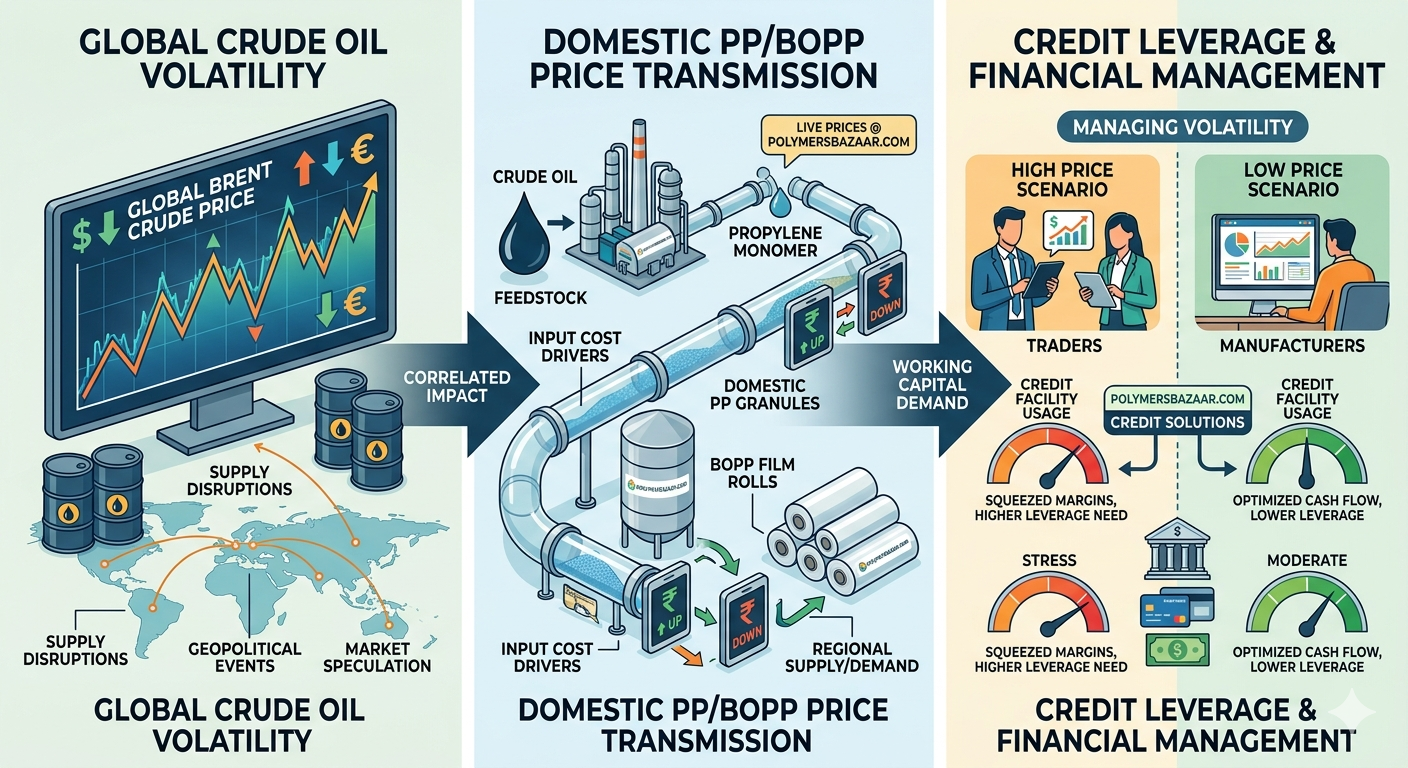
To trade effectively on Polymers Bazaar, it is critical to understand the two external forces that drive your profitability: the global price of crude oil and the internal cost of capital.
Here is a deep dive into how global energy markets dictate your raw material costs and how you can use the platform's financial tools to mitigate these risks.
1. The Crude-to-Plastic Connection: Why
Prices Fluctuate
Many buyers are often caught off guard when
domestic PP (Polypropylene) or BOPP prices jump overnight. This volatility is
rarely random; it is a direct downstream effect of the global energy supply
chain. Since India imports over 80% of its crude oil, local polymer prices are
tightly coupled to the Brent Crude and Naphtha benchmarks.
The Pricing Chain Reaction
- Upstream (Crude Oil): When
geopolitical tensions or supply cuts (e.g., OPEC+) drive Brent Crude
prices up, the cost of Naphtha—a primary derivative of crude
oil—rises immediately.
- Midstream (Propylene): Naphtha is
cracked to produce Propylene, the base monomer for all PP and BOPP
products.
- Downstream (Resin/Film): Domestic
petrochemical majors (like Reliance, IOCL, or GAIL) adjust their
"List Prices" for PP Injection and BOPP grades to reflect these
higher input costs. This usually happens with a lag of 1–2 weeks, known as
the "pass-through" period
How the Platform Helps You Navigate
Volatility
- Price Lag Advantage: By monitoring
"Crude" and "Naphtha" alerts on the Polymers Bazaar
app, you can predict a domestic price hike before it is officially
announced.
- Lock-in Capability: If crude prices spike today, you can use the platform to buy available stock at current old rates before the manufacturers revise their price lists next week.
2. Financial Flexibility: Payment Terms
Comparison
Cash flow is often the biggest constraint
for SMEs. Polymers Bazaar offers distinct payment structures designed to suit
different business sizes—from cash-rich traders to manufacturers needing
working capital.
|
Feature |
Advance Payment (RTGS/NEFT) |
Credit Line (Channel Finance) |
|
Best For |
Traders with surplus cash looking for the
lowest possible unit price. |
Manufacturers who need to convert raw
material into finished goods before paying. |
|
Cost Benefit |
Maximum Discount: Sellers often offer a "Cash Discount" (CD) of ₹0.50 –
₹1.50 per kg for immediate payment. |
Liquidity:
Keeps your bank cash free for operational expenses like wages and electricity. |
|
Approval Time |
Instant (Immediate dispatch upon proof of
payment). |
24–48 Hours (One-time credit assessment
required). |
|
Payment Cycle |
100% upfront before lifting. |
15 to 90 Days credit period (depending on insurer/bank limits). |
|
Platform Role |
Escrow Safety: Money is held securely
until dispatch is confirmed. |
Digital Facilitator: Connects you with
NBFC partners to approve your limit against GST data. |
Pro Tip:
Smart buyers often use a hybrid approach. They use Advance Payment for
fast-moving standard grades (to grab cash discounts) and utilize their Credit
Line for bulk stocking during off-seasons or ahead of predicted price hikes
Ready to Trade Smarter?
Don't let market volatility eat into your
margins. Use the intelligence tools on Polymers Bazaar to time your purchases
and the flexible credit options to manage your cash flow.
- Check Live Crude Trends: View
real-time upstream data.
- Apply for Credit: Submit your GSTIN to unlock your buying limit.