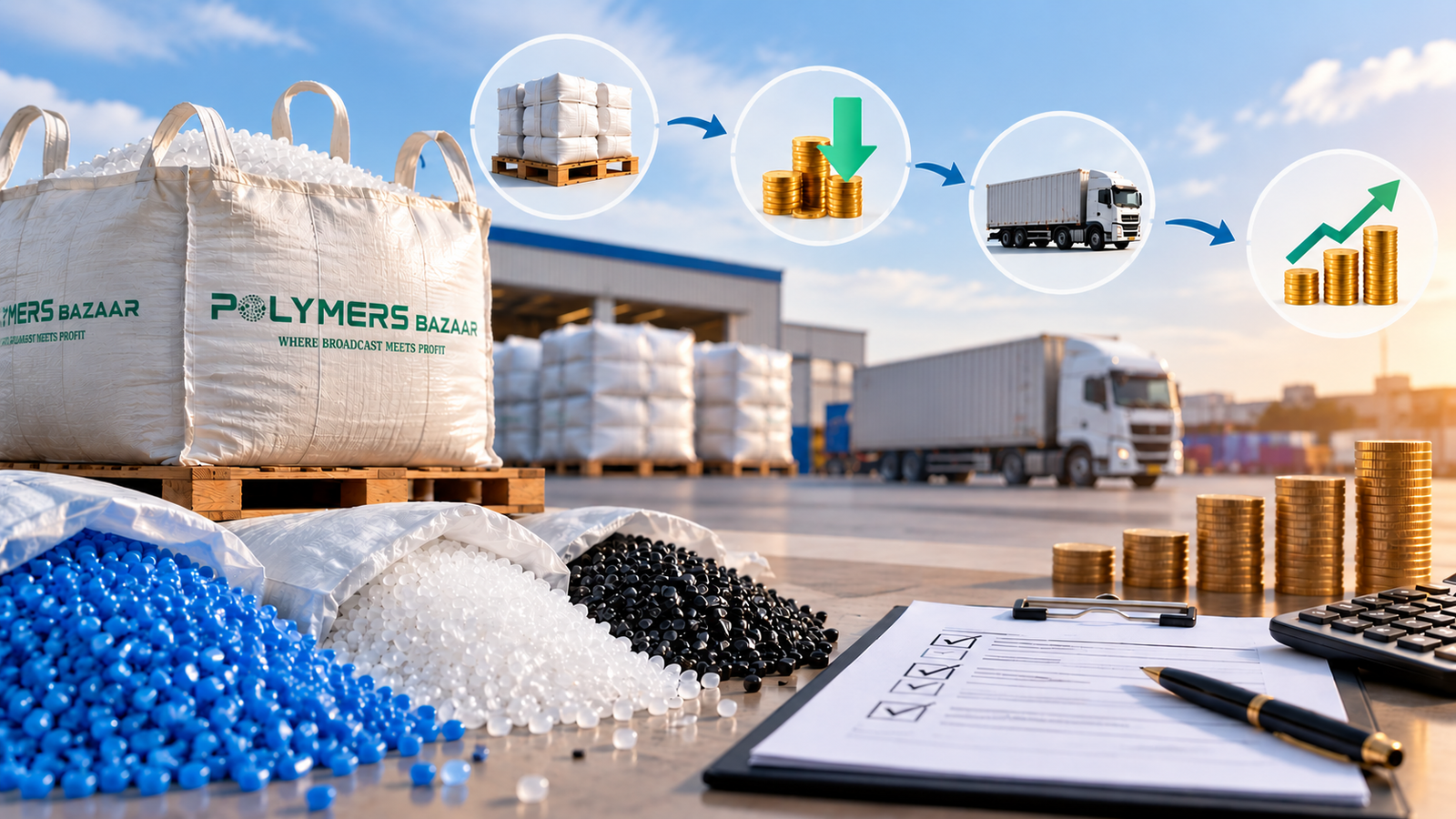
Most polymer
quotes include a rate and a minimum quantity, and buyers are usually obsessed
with the former. However, for a small or medium-sized manufacturing unit in
India, the minimum quantity is often more important than the rate. It tells how
much money will go out of the business’s pocket on day one and how long the
purchased material will stay stored in the warehouse. This article discusses
the impact of polymer MOQ on the price and working capital, what to do before
accepting an MOQ, and how to check if a bigger order is indeed cost-effective.
What Is Polymer MOQ?
Polymer MOQ, or
minimum order quantity, is the smallest amount of resin or granules a supplier
will sell in a single order. It is usually set in tonnes or bags, and the
quoted price applies at or above that quantity. If you order below it, the supplier
may refuse the order or charge a higher price per unit.
One practical
tip: check whether the MOQ applies to the material itself or to the packaging.
They are not always the same thing.
Why MOQ Matters for Buyers in India
Smaller buyers
are more sensitive to MOQ than larger ones. Storage space and limitations on
working capital are typical for Indian start-ups and small companies, and the
tie-up of cash with slow-moving stock can be a significant problem for a small
enterprise.
The location of
the buyer also plays a role. In India, polymer manufacturing is concentrated in
two states – Gujarat and Maharashtra, which creates a significant distance for
many buyers and increases the transportation cost. Therefore, for an enterprise
that is not in these regions, an order with a large MOQ will involve additional
costs and a longer production cycle.
How MOQ Affects Polymer Price
In general,
larger orders get a lower rate per unit, and orders below the MOQ cost more.
That is why a higher quantity looks attractive on paper.
The catch is
that the quoted rate is only the starting point. Freight depends on distance,
truck availability, fuel, and shipment size. A supplier with a slightly higher
rate can still have the lower landed cost if freight and delivery are better.
If you are
comparing offers for bulk polymer raw materials online, ask
every seller for the MOQ, packaging, and delivery terms along with the rate.
Quotes only become comparable when those details match.
How MOQ Affects Working Capital
A bigger MOQ
means more money paid upfront and more stock sitting unused. The longer it
sits, the more it costs you.
The true cost of polymer procurement is a
useful way to see this. It adds material cost, freight, applicable charges,
financing cost, quality-related cost, and inventory cost, rather than looking
at price per tonne alone.
Inventory
holding cost is the part buyers underestimate. General inventory references
commonly put it at 20% to 30% of inventory value per year, covering capital,
storage, and risk. That range is not specific to polymers, so replace it with
your own cost of funds if you know it.
Key Factors to Consider Before Accepting an MOQ
Before
committing to a quantity, five checks are worth running. Together they show
whether the slab discount is real.
1. Price per Tonne at Different Slabs
Ask for prices
at more than one quantity, including the MOQ and one step below it. The gap
between them is the real discount being offered.
2. Freight and Handling
Compare
freight, GST, loading, and documentation charges on the same basis for every
supplier. A saving on resin can disappear in transport.
3. Monthly Consumption and Stock Turnover
Divide the MOQ
by monthly use. If it covers one or two months, that is usually manageable. If
it covers six, the business is financing a warehouse.
4. Storage Space and Shelf Life
Granules need a
cool, dry, shaded area. One PP safety data sheet cited by Polymers Bazaar gives
a minimum shelf life of one year from manufacture, with proper packaging and
storage, and a stacking limit of two pallets on sound flooring. Hygroscopic
grades such as nylon, ABS, and PBT need extra moisture care.
5. Payment Terms and Credit
Advance payment
on a large order strains cash far more than the same order on credit. Polymers
Bazaar states that eligible buyers can get credit after its evaluation, so
confirm terms before deciding on quantity.
Practical Example
This example
is hypothetical and uses assumed numbers, not real quotes.
A converter
uses 10 tonnes of PP a month. Supplier X sells 10 tonnes at ₹1,02,000 per
tonne. Supplier Y sells only in 20-tonne lots at ₹1,00,000 per tonne.
•
Two months from Supplier X: 20 tonnes × ₹1,02,000 =
₹20.4 lakh, paid in two parts.
•
One lot from Supplier Y: 20 tonnes × ₹1,00,000 = ₹20
lakh, paid at once.
•
Headline saving: ₹40,000.
•
Extra holding cost: the unused 10 tonnes (about ₹10
lakh) sits for a month. At an assumed 25% annual carrying cost, that is roughly
₹21,000.
The net saving
shrinks to about ₹19,000, and ₹20 lakh is paid on day one instead of ₹10 lakh.
If Supplier Y also charges more for freight, the deal could turn negative.
Common Mistakes
•
Choosing on rate alone. The lowest quote is not
always the lowest landed cost.
•
Overbuying to hit a slab. Extra stock raises
storage cost and ties up cash.
•
Ignoring payment terms. Advance-only terms can
hurt if credit was assumed.
•
Accepting the first quote. One quote gives
nothing to compare against.
•
Skipping the packaging check. The packaging, not
the polymer, sometimes sets the real minimum.
•
Poor storage of bulk stock. Damp floors and tall
stacks can ruin material that is already paid for.
Practical Recommendations
Start by
finding out what drives the MOQ. General sourcing guidance suggests it is often
the packaging. Then ask whether a smaller lot is possible at a modest per-unit
premium, and compare more than one supplier, since smaller ones can be more
flexible.
Send the same
detailed request to several sellers so quotes can be compared properly. For
buyers planning to buy polymers in bulk through a marketplace,
Polymers Bazaar says buyers can send one RFQ to multiple verified sellers and
compare price and commercial terms in one place. Spell out grade, quantity,
packaging, and delivery city so the quotes line up.
Key Takeaways
•
MOQ affects both unit price and upfront cash.
•
Compare landed cost, not quoted rate.
•
Match MOQ to monthly use and storage space.
•
Always ask about payment terms before committing.
•
Run the numbers on a bigger order before assuming it
saves money.
Conclusion
A good MOQ is
something that cash flow and inventory turnover can absorb comfortably. The
sensible approach is to evaluate slabs, plus freight and holding cost, and
payment terms, before agreeing. Looking past the headline rate helps you to
pick an order size that protects your margins.
FAQs
What does MOQ mean in polymer
buying?
It is the
smallest quantity a supplier will sell in one order at the quoted price.
Does a higher MOQ always lower the
price?
No, because
freight, financing, and storage costs can cancel the slab discount.
How does MOQ affect working capital?
A larger MOQ
means more cash paid upfront and more stock held, which raises holding costs.
Can I buy below the MOQ?
Sometimes, but
suppliers usually charge a higher price per unit or may refuse the order.
How long can bulk polymer granules
be stored?
One PP safety
data sheet gives a minimum shelf life of one year from manufacture under proper
conditions.