Buying polymer in bulk often comes down
to a grade name, a price, and a delivery date. The material itself is rarely
seen until it arrives, and that gap is where problems start. Some resin sold as
premium is reprocessed, blended, or mislabeled. Many processors also file a
supplier's certificate without reading it, then discover a borderline lot only
when defects appear on the line weeks later.
Buyers searching for polymer quality
inspection usually want one thing: a practical way to confirm what they are
paying for before money and production time are committed. This article covers
the documents to check, the properties worth testing, and the mistakes that
cause the most trouble.
What Is Polymer Quality Inspection?
Polymer quality inspection is the process
of verifying that a polymer lot matches its stated grade and specification
before it is accepted or used. It combines document review, property checks
such as melt flow and density, visual inspection, and lab tests like FTIR
spectroscopy to confirm polymer identity. The goal is to catch the wrong resin,
contamination, or off-spec material before it reaches production.
Why Checking Polymer Quality Before Buying Matters
Material mix-ups lead to product defects
and costly downtime. Small spec gaps also add up. In PVC, a K-value two points
off shifts melt viscosity by roughly 18%, and volatiles above 0.3% can leave
gas marks and voids in parts.
Off-grade lots carry extra risk. They
often arrive with thinner documentation, and the savings disappear if one lot
scraps a run. Checking before purchase costs far less than fixing problems
afterward.
Key Factors to Check Before You Buy
Not every check carries the same weight.
The five below move from low-cost document review to hands-on verification, so
a buyer can stop early when a supplier fails a basic test.
1. Supplier Credibility
and Traceability
A reliable supplier tests batches using
representative sampling, issues a COA for each lot, and keeps records of
production conditions and additives. That record lets any defect be traced back
to its source. Ask about retained samples and quality documentation. On
marketplaces, look for platforms that vet sellers. Polymers Bazaar, for
example, states that it onboards verified businesses and runs KYC checks.
2. Technical Data
Sheet Verification
A technical data sheet (TDS) lists a
manufacturer's typical values for a grade. These values suit screening, but
only when compared under the same test method and conditions. Read the test
standard first, because TDS formats are not standardized and manufacturers
report different sets of properties. This guide on how to read a polymer technical data sheet
explains the main sections. Always confirm that the grade on the TDS matches
the grade on the quotation.
3. COA and Batch
Matching
A TDS shows typical values. A certificate
of analysis (COA) shows results for one specific lot. The lot number on the COA
must match the number on the container label, and a mismatch is described as
the most common verification failure found in supplier audits.
Compare each result against the buyer's
own specification, not only the supplier's pass or fail note. Also check that
every parameter lists its limit and its actual result, along with a test date.
4. MFI and Key
Property Checks
Melt flow index (MFI) is the weight of
melt, in grams, that flows through a standard capillary in 10 minutes under
ASTM D1238 or ISO 1133. Polyethylene is commonly tested at 190°C and 2.16 kg,
and polypropylene at 230°C and 2.16 kg. Because conditions change the number,
MFI values only compare when test conditions match.
MFI is also an indirect marker of
molecular weight and is often used to check batch-to-batch consistency. Density
adds a second signal, since a mismatch can point to another resin mixed in.
This overview of MFI for polymer grade selection shows how flow
ranges connect to processing needs.
5. Physical
Inspection and Sample Testing
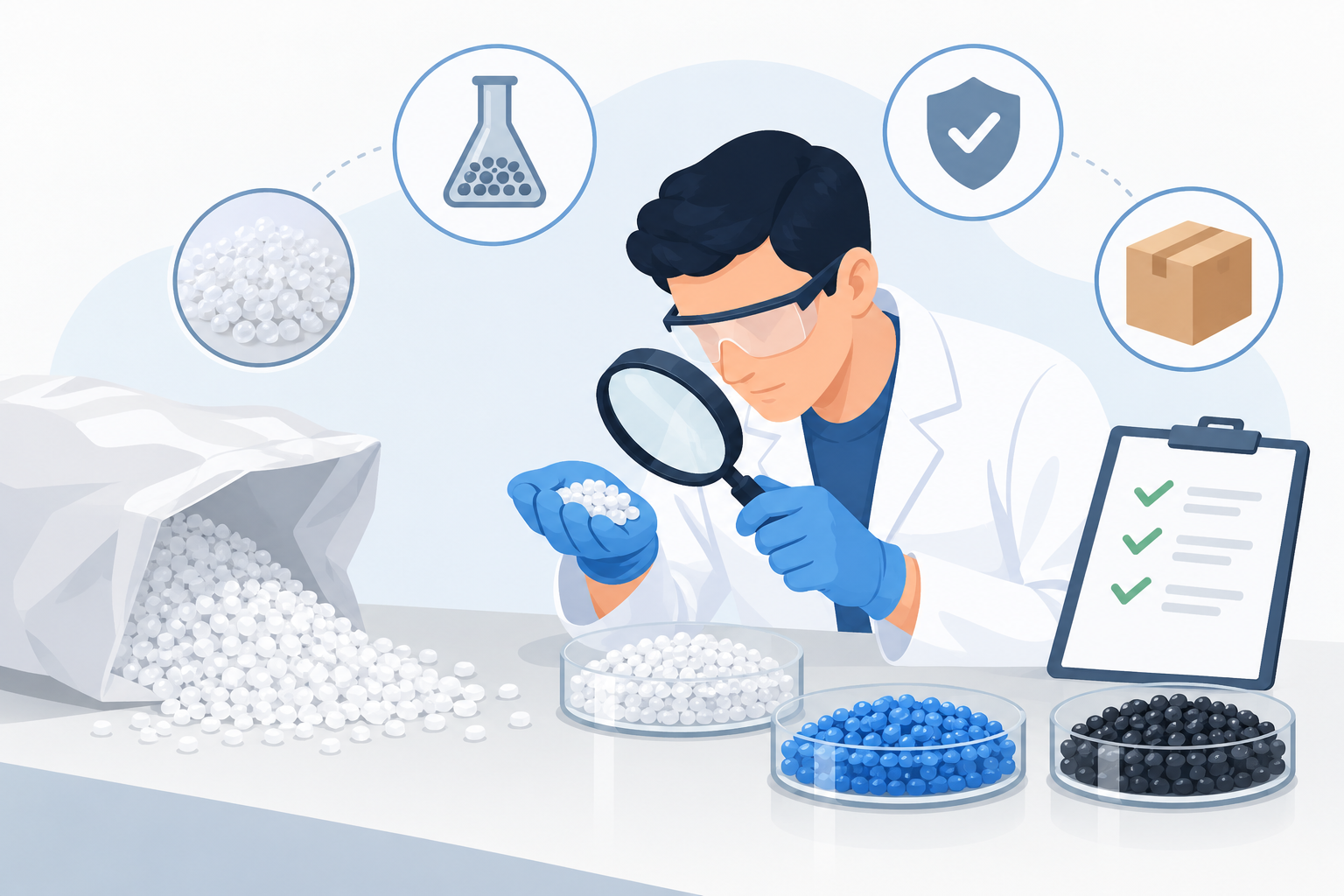
Packaging is the first thing to check.
Damaged or UV-degraded bags are a reason to test before processing. Pellets
should be checked for contamination, moisture, and unusual color variation.
Color alone does not prove quality, but it is a useful visual signal.
For larger orders, lab methods add
certainty. FTIR identifies the polymer family, DSC checks melting behavior
(unexpected peaks suggest blending or contamination), and TGA measures filler
content. Testing a trial quantity before a full container order keeps the risk
small.
Practical Example: A Pre-Order Inspection Workflow
The following scenario is illustrative,
not a real case. A film extruder plans to order polypropylene for a new product
line. The buyer first requests the TDS and a recent COA, then confirms that the
grade and MFI range suit the machine. The COA values are compared against the
buyer's own specification.
Next, a trial quantity is ordered. On
arrival, the lot number on the COA is matched to the bags, pellets are
inspected, and MFI is tested at 230°C and 2.16 kg. Only after the trial runs
cleanly does the buyer place the larger order.
Buyers who want to compare several
suppliers at that stage can buy
bulk polymer raw materials online through Polymers Bazaar, where a
single RFQ goes to multiple verified sellers. Quotations, pricing, and
availability can then be compared side by side.
Common Mistakes
●
Filing the COA without reading
it. A borderline value often predicts a defect, so
review each parameter.
●
Accepting a COA for the wrong
lot. Match the lot number to the container every time.
●
Comparing values from different
test methods. Check the standard and conditions behind
each number.
●
Treating off-grade material
like prime. Test it independently before use.
●
Skipping trial quantities. A small trial costs far less than a scrapped production run.
Key Takeaways
●
Work in order: documents first,
then properties, then physical checks.
●
A TDS shows what a grade typically
does, and a COA shows what this lot did.
●
Match test conditions before
comparing MFI or any other value.
●
Verify the supplier before testing
the material.
●
Trial first, then scale up.
Conclusion
Polymer quality inspection does not need
a full laboratory. A buyer who reads the TDS, matches the COA to the lot,
checks MFI conditions, and inspects a trial sample can filter out most bad lots
before real money is committed. The right approach turns buying from a leap of
faith into a repeatable routine, and it protects both budgets and production
schedules.
FAQs
What documents should I request before
buying polymer?
Ask for the TDS, SDS, and a recent COA at minimum. For
approved supply, also ask about lot traceability and retained sample policies.
What is the difference between a TDS
and a COA?
A TDS gives typical values for a grade. A COA reports
measured results for a specific lot.
How do I verify a COA is valid?
Match the lot number on the COA to the container
label, and compare each result to your own specification. Check the test date
as well.
Does pellet color show polymer
quality?
Color alone does not decide quality, but it is a
useful visual indicator. Unusual variation is worth investigating.
Why does MFI matter when buying
polymer?
MFI shows how easily a melted thermoplastic flows and
is often used to check batch-to-batch consistency. Values only compare when
test conditions match.